Donate US

 photo cub_buttonUSA_zps260251ee.png  photo cub_buttonAllOther_zps266319dc.png

Tuesday, 19 November 2013

Busch Gardens at CCF - Angie Minter

My name is Angie Minter and I have come to CCF as a Conservation Ambassador on behalf of the SeaWorld and Busch Gardens Conservation Fund.  I am the Training and Development Manager for the Culinary Departments at Busch Gardens and Water Country USA in Williamsburg, Virginia.  I was selected as the first Conservation Ambassador outside of the Zoological team in the company.  When asked if I was interested in traveling to Africa, I jumped at the chance.  SeaWorld Parks and Entertainment is committed to conservation and education and what an amazing opportunity to “walk the talk”.  I believe in the core values and commitment of our company to “celebrate, connect and care for the natural world we share through the power of entertainment”.  Traveling to the Cheetah Conservation Fund took those core values and made them real and actionable for me.  This opportunity was so much bigger than anything I could have ever imagined for myself.

Angie at center of frame
Arriving at CCF in Namibia, I was astounded at the natural beauty of Africa and its animals.  As I started to get involved in the work here at CCF, I was overwhelmed by the dedication the staff and interns here have to saving the species.  I was able to experience everything from feeding dogs to cleaning goat pens to feeding cheetahs to making cheese and feeding staff.  My favorite thing by far was riding in the back of the truck, exercising the releasable cheetahs, just before feeding them.  What an awesome experience to see the girls in their natural habitat doing what nature designed them to do.

I have enjoyed every minute of my two weeks at CCF and feel like I could stay another two weeks.  I hope I have made an impact here at CCF because I know CCF has made an impact on me.  I intend to do my part to spread the message that humans can live in harmony with predatory wildlife, given the tools and resources and following the model that has been developed here at CCF.

Friday, 15 November 2013

Update from Erindi

And so, Luna and Athena carry on in their new home (Erindi Private Game Reserve), adjusting to their new surroundings.  The staff of Erindi is very interested and has been helpful in the re-wilding process of these two females and the tourists have enjoyed the opportunity to witness it first-hand.

After her first week, Luna welcomed tourists to the opportunity to view her, but was not yet capable of hunting successfully.  On 26 October, day twelve of her re-wilding, this changed.  Luna managed to make her first kill at the release site waterhole.  She took down an adult female impala and performed a flawless neck bite, which killed the ewe in minutes, giving the Erindi staff and tourists a memorable perspective of a cheetah’s kill.  After catching her breath, she fed in the heat of the day beneath the tranquil shade of an acacia tree.  As night fell, and Luna relaxed beside her kill, she was visited by the dangerous unknown.  A pride of lions, known as the Etosha Pride, caught wind of Luna’s kill and quickly approached her.  Two of the younger male lions charged Luna and unexpectedly she had the intuition to run, and run fast, away from these much larger felids.  An encounter such as this with a proper response from Luna is a necessary behaviour for survival in Erindi.  Despite never being exposed to lions in her nine years of life, and the unfortunate circumstance of being chased off her first kill, Luna managed to excel at the simple task of surviving, of taking flight.

Luna eating her impala kill
Since her first kill, Luna picked up on the routine of hunting when hungry, and she has managed to kill a scrub hare and a steenbok.  She habitually returns to the release site waterhole to drink, which acts as the core of her range thus far.  She travels to explore new areas of Erindi, averaging a 1.5-5km radius from the water point.  Towards the end of her third week in the wild, Luna seems to be struggling a bit to hunt successfully again, but has been seen hunting steenbok and oryx calves. However we are still providing supplementary food between her successful kills.

Luna killing steenbok
Athena has embraced her newfound freedom, but is presenting us with different challenges than Luna.  She is difficult to track and monitor, as she continues to avoid the tracking team and seeks safety in koppies (large hills composed of rocks/boulders), which are difficult to track on and can be dangerous due to the presence of leopards. She had hunted and killed regularly, but she still has not found a consistent water source, so we have supplemented her with water.

Athena near a koppie
Athena eating a waterbuck
At the end of October, we lost Athena’s signal and later found it outside of the reserve on a neighbor’s farm.  After communicating with the neighbor he allowed us to find Athena and dart her in order to bring her back to Erindi.  We successfully darted Athena and we placed her in a holding area inside of Erindi to attempt to settle her better in her new area. Re-wildling is a very difficult process, which requires constant monitoring.  We will continue to keep you informed on the progress of Luna and Athena’s release.

Reporting from Erindi,

Ryan Marcel Sucaet
Asst. Cheetah Keeper & Research Asst.

Thursday, 14 November 2013

Busch Gardens at CCF - Erin Moloney

Hi, my name is Erin and I am a senior animal care specialist working with cheetah at Busch Gardens in Tampa Florida. For the past two weeks, I’ve have the wonderful opportunity to volunteer at CCF and experience firsthand conservation in action as an Ambassador for the SeaWorld and Busch Gardens Conservation Fund (SWBGCF).  SWBGCF donates over $1million to various conservation organizations around the world including CCF while also sending select employees abroad to help with conservation directly.


My two weeks at CCF have been a life changing experience. With my background in animal care, I’ve primarily helped the husbandry staff care for the 50 resident cheetahs, most of which, for one reason or another, cannot be released into the wild. The cats are great but the staff that cares for them are truly incredible! They practically work from sun up to sun down ensuring that everyone is well fed and cared for – definitely not an easy thing to do with so many cats here.  These two weeks have been full of memorable experiences but my favorite was getting to feed wild game to a group of female cheetahs. Nothing goes to waste here in Africa, and this experience demonstrated that.

I’ve also really enjoyed learning more about the education programs developed by CCF to help local farmers. Before coming here, I knew about the Livestock Guarding Dog Program but I didn’t realize how much other farming education (like routine medical care training and record keeping) CCF offers to farmers to improve their farming methods. They empower the farmers to better care for their livestock and successfully share the land with cheetah and other predators. The methods CCF teaches are ones that can, and should, be used worldwide to enable farmers and predators to live together in harmony.


Through this experience, I’ve gained a better understanding of the work of CCF and the challenges cheetah and other carnivores face. While I know there is more I can learn here and leaving the animals and staff will be difficult, I can’t wait to share my experiences and educate others about the wonderful work CCF is doing and how humans and predators can successful share this Earth.

Saturday, 9 November 2013

Hifi: The End of an Era


Last week we recovered the remains of Hifi, one of our wild but resident cheetahs that we have monitored for over five years. We do not know why or how he died, but his remains were found in CCF’s Little Serengeti (the Big Field). Tiger, one of our scat detection dogs, discovered his remains in a location nearby the latest GPS coordinates downloaded from his tracking collar. The scat detection team, Eli and Stephanie, immediately alerted other CCF staff His last confirmed sighting was at the end of September when he was observed on a red hartebeest kill. 

Everyone who has visited CCF over the past five years has heard the story of Hifi; the wild cheetah who chose a home range encompassing CCF‘s Centre and who was regularly seen with his brother, Sam (who died roughly 3 years ago), courting the captive non-releasable female cheetahs at our Centre.

Patricia Tricorache took this lucky shot of a majestic looking Hifi right outside one of our female cheetah enclosures
It is hard to put in words how sad we are to know that Hifi is no more, but as sad as this is it is the harsh reality of life in the wild. Every day is a fight for survival and Hifi, with an age of over eight years, did brilliantly. He always had a full belly and was never bothered by other cheetahs in the area.

CCF caught, examined, collared, and released Hifi and Sam for the first time in 2008 on Namibia’s Independence Day (March 21), and thus were named after the Founding President of Namibia, H.E. Sam Nujoma, and our current President, H.E. Hifikepunye Pohamba, who were and still are the ultimate guardians of wildlife in Namibia.  

Camera trap photo of Hifi marking territory near one of our cheetah enclosures
Data from Hifi and Sam has contributed much to our knowledge of cheetah biology and ecology, as the opportunity to monitor and study an individual cheetah(s) for such an extended period of time is a very rare opportunity indeed. Through satellite collar downloads, camera trap photos, spoor tracking, and regular scat collection, CCF has gained valuable insight into the daily distance moved, home range, feeding behaviours, and habitat use of wild cheetahs. In addition, his visits to our Centre allowed us to monitor the oestrus cycles of our captive female cheetahs and study the unique behaviours that correlate with oestrus.

Map of the data downloaded from Hifi’s collar. The blue points are each individual download, the yellow lines are the borders of CCF’s farms.
Occasionally we had the opportunity to study Hifi more closely whilst doing a work up under anaesthesia to change his radio collar. This enabled us to collect blood samples for monitoring his overall health, to conduct DNA analysis, and to collect and freeze sperm samples from him for our Genome Resource Bank. Overall cheetah sperm is of poor quality due to the lack of genetic diversity throughout the species, and though his was not much different structurally during his last work up we were able to bank 39 straws of sperm, which is an amazing quantity (average is 5-10 straws).
 
Dr. Laurie Marker and Rob Thomson fitting Hifi with a GPS/VHF collar for monitoring his movements.
Over the last five years we have gathered a huge amount of data not only from the work ups and his satellite collar but also from his scat. We have collected over 800 scat samples in total whilst carrying out our daily ‘scat walk’ around the Centre. The scat allows us to conduct research on the diet and prey preferences of HiFi and to study his DNA extracted from the scat in our genetics lab. The scat will also be used in hormone studies to learn more about the relationship between hormones and stress in wild cheetahs. We are currently looking for funding to complete these studies.
 
Hifi sniffing at a play tree, taken by one of our camera traps.
Over the past five years Hifi has been captured and released seven times! Many CCF volunteers and interns have observed these procedures and cherish these memories. Hifi learned to live with us all; people, dogs, and small stock and was only interested in our/his female cheetahs living at our Centre.

Lucia, Matti, Jenny, Eli and Dr. Laurie Marker releasing Hifi July 2013.
In the past five years, Hifi has taught us so much. We lived together in harmony and got to know his movements and behaviour in a very unique way. He will be remembered by all of us at CCF. We hope that there are many little Hifi’s running around in the wild to ensure he lives on and continues to help in the cheetah’s race for survival.
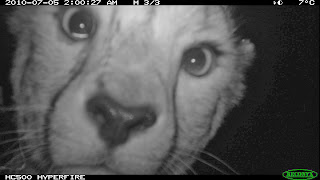
Hifi investigating a camera trap - “What is this???”