Donate US

 photo cub_buttonUSA_zps260251ee.png  photo cub_buttonAllOther_zps266319dc.png

Thursday, 4 August 2011

Meet Penda's Puppies

Hi everyone!

Yesterday, Penda gave birth to six healthy puppies; three males and three females. Penda is doing well and all the puppies are suckling and growing already.


Each day the puppies are weighed to check that they are putting on weight and developing properly. Penda is given extra food at this time to ensure that her puppies obtain all the nutrients that they need at this critical stage of their lives.

Rosie

Wednesday, 3 August 2011

Another birth at CCF: Susie, a dairy goat, gives birth.

Susie, a dairy goat of the herd at CCF gave birth to a healthy female kid yesterday.The little new-born will stay with Susie until about a week old, at which point CCF staff will bottle feed her to allow the milk from Susie to be used in CCF's cheese-making process.
Joeh, goat kraal manager, with Susie and her new-born female kid.
This is the fourth dairy goat born at CCF in 2011.


Rosie Glazier, DVN
Veterinary Nurse

Tuesday, 2 August 2011

New puppies due any moment...

Joeh, goat kraal manager, taking care of Penda
Penda, a 6 year-old Anatolian Shepherd cross, is due to give birth in the next couple of days.

The animal care and veterinary teams are working with student interns and volunteers to monitor Penda by taking her temperature twice daily. As soon as there is a drop in temperature we will know that within that day she will give birth to her litter. The volunteers will be involved in the daily care and monitoring of Penda and her puppies. Within a few weeks from birth, and prior to placement, CCF performs basic health treatments on the puppies such as de-worming and vaccinations, as well as sterilisations. These young dogs at around eight weeks of age will be placed on various farms in Namibia to serve as Livestock Guarding Dogs.

Penda - Waiting...
Penda has had many successful litters in the past. Her latest was in June 2010 when she raised nine healthy pups.

We will keep you posted.

Rosie Glazier, DVN
Veterinary Nurse

Monday, 1 August 2011

Ecology Team reporting: CCF's Annual 12-hour Waterhole Count

Last Saturday, 30 July, marked the 17th Annual Waterberg Conservancy Waterhole Count. This conservancy-wide count provides population and density estimates and trends for various game species throughout the Waterberg Conservancy farms. Through continued regular monitoring of wildlife populations utilising the Conservancy lands, more effective conservation of game species will be possible. Since the beginning of these counts in 1995, we have seen increases in most games species across the Conservancy farms.
Here at CCF we counted 25 waterholes across seven farms from 6am to 6pm. This year we had 50 participants helping with the counts, including 22 teachers from Miami University Ohio's Earth Expeditions, 16 students from Mesa Community College Arizona, 10 school kids from the Otjiwarongo Arts Centre, and CCF interns.

After an early morning, breakfast at 4:30 am, participants were driven out to their hides to start counting at 6am. They braved the cold and windy weather and finished the day in high spirits with a big smiles on their faces. For some of the participants from Otjiwarongo, this was their first opportunity to see a lot of these species in the flesh. In addition to baboons, giraffes, zebras and elands, highlights of the day included two different sightings of leopard and a sighting of one of black rhino.

Above: One of CCF's black rhinos sighted during the 12-hour waterhole count. Below: One of two leopard sightings.


This week we continue our annual game counts with transect counts across all our farms. We will drive over 300 km counting game on CCF property. We will keep you updated with any exciting results.

In other news, our resident wild cheetah HiFi made an oryx kill right by one of the cheetah pens near Lightfoot camp. One of CCF's interns found the kill in the morning, and photos from our camera trap a few hundred meters away captured HiFi, bloody faced and full bellied early that morning, confirming it was indeed him.
HiFi - camera trap image.

Cheetah greetings to all,

Kat

Monday, 25 July 2011

New cheetah cubs in the area!

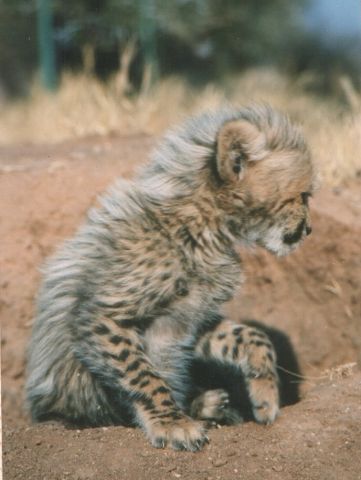
We have exciting news. Remember the female cheetah with her 2-year old sons that we released at the end of February when the Wildlife SOS film crew was here from the UK? She had a tooth extracted and we put a satellite collar on her to track her (photo - above). We tracked the collar last week and found her and three cubs in high grass. Here is a photo we were able to capture of two of the cubs.

Laurie

N.E. A cheetah's gestation period is about 95 days, and the average litter size is 4-5 cubs.

Sunday, 24 July 2011

Chester the Cheetah's Knee Surgery

Hello. I am the new vet for CCF, I have been here two weeks.
Chester
Chester, one of CCF's resident cheetahs, was taken to the Otjiwarongo Vet Clinic on Friday for knee surgery. He had been limping for about three weeks. After taking x-rays last week, it was determined that surgery was needed.
Chester on his way to the Clinic
Chester initially had surgery in February of 2008, when he was found as a wild-caught cheetah in a trap cage, where he had been for almost a month, with a fractured femur (leg bone) near the knee. A bone plate was put in at that time to repair the fracture, and he has been doing well since then. A few weeks ago he started limping quite badly on the leg that was previously broken, and we anaesthetised him on 12 July to try and assess what was going on. Radiographs were taken at Axel Hartmann’s clinic in Otjiwarongo which showed loosening of some of the screws in the plate. Also the knee was very stiff with reduced range of motion and there was significant inflammation in the knee joint. We decided to anaesthetise him and remove the bone plate, since the fracture had healed long ago. The surgery was done on 22 July and was successful. The entire plate and all the screws were taken out (photo - left), with myself and Dr. Hartmann performing the surgery and Rosie Glazier, our veterinary nurse, monitoring anaesthesia.
Chester just after surgery.
Chester is now recovering in a small quarantine enclosure and seems to be feeling better already. He is standing and walking on the leg and is eating well. He is receiving antibiotics and pain medications daily in his food. He doesn't have many sponsors. If you would like to sponsor him, please click here.

Gabriella Flacke, DVM, MVSc

Friday, 15 July 2011

July: Celebrating Chewbaaka and Freedom.

All my colleagues at CCF Namibia are preparing for CCF's biggest annual event in Windhoek tomorrow: our fundraising gala, a Celebration of Speed and Elegance, which takes place every year in July and this year will honour the greatest cheetah, Chewbaaka.

July is a special month for us at CCF. For 15 years, we celebrated Chewbaaka's birthday, and for the rest of our lives, we will celebrate his life and legacy. I can't think of the many achievements made by CCF without appreciating the important role Chewbaaka played --and continues to play-- in cheetah conservation.

As it turns out, July is also a big month when it comes to celebrating freedom. 22 countries celebrate their independence in July, including the US and six African countries: Burundi, Rwanda, Somalia, Malawi, Egypt, Ethiopia and Liberia.

Thinking of Chewbaaka and freedom reminded me of one of CCF's great achievements: the successful re-wilding of several cheetahs in the last few years.

Did you know that the five Chocolates now roaming free in NamibRand and the Erindi Game Reserve (Toblerone, Nestle, Hershey, Cadbury and Lindt) were all born in July 2002? The five siblings came to CCF after having been caught in a farm near Otavi. Strangely, their mother was never found. We believe she was shot since cheetah mothers don't typically abandon their cubs. The males Cadbury and Lindt were released in Namibrand in July 2008 along with coalition members Mushara, Ra and Kia. The females Hershey, Nestle and Toblerone went to Erindi with a fourth female, Chanel, last January.

Seven years later, also in July, four tiny and scared orphan cubs (photo - right) that we affectionately named the "Scars" --Phil, Mischief, Tony and Polly, were born and came to CCF. We loaned all three males to the Naua Naua Lodge, where they have been enjoying life and educating visitors at this game reserve since last March.


So, here is to a very successful CCF gala in Namibia tomorrow, and to Chewbaaka and free cheetahs!

Happy July everyone. And please remember, the Chewbaaka Memorial Challenge is on, and it will only last through 31 August. Please donate now and make your donation count twice!

Patricia

Thursday, 30 June 2011

International conservationists' intensive training at CCF.

For the past three weeks, CCF has been hosting the 6th International Cheetah Conservation Biology Training Course. The objective of these courses is to train conservation biologists from the cheetah’s range countries in proven methods of cheetah conservation, so that they can become trainers of these methods in their respective home countries. In this course we have 26 participants from Botswana, Zimbabwe, Zambia, Ethiopia, Niger, Iran, Uzbekistan and India, as well as large cat experts from Brazil, and the UK.

International course participants with Laurie and Bruce, CCF USA Trustee Polly Hix and her husband Tony Fair. (c) Cheetah Conservation Fund, 2011.
So far the participants have spent much of their time learning from lectures by CCF staff as well as guest speakers from Namibian conservation and research organisations, university lecturers from the United States and specialists from Botswana. Lectures have addressed a variety of topics including, large-scale conservation, range land management, cheetah behaviour, husbandry and feeding ecology, habitat studies, management plans, rapid sociological studies and human-wildlife conflict. The group has also been involved in practical sessions, learning skills such as radio-tracking, vegetation surveys, diet analysis using hair from scat samples, cheetah immobilisations and collecting biological samples.

Hands-on learning with a cheetah immobilisation in the clinic. (c) Cheetah Conservation Fund, 2011
Last week the course travelled to the Sesfontein Conservancy in Namibia’s North-West. Here they put some of their new skills into practice by conducting a rapid survey of the area including game counts, habitat description and a sociological survey focusing on human-wildlife conflict as well as conducting training for the community members to help them deal with predator problems in their conservancy.

Kat Forsythe

Sunday, 19 June 2011

Coughing Cheetahs

Several of our cheetah have developed a dry cough. It appears to be either viral or bacterial in nature, as several cats living together all have contracted it. We have them on supportive antibiotics and are keeping a very close eye on them. Currently, none of them are critical and we think that our careful observations will alert us to any major problems. Another of our cheetahs it appears has been stung by a bee and we administered anti-inflammatory and supportive antibiotic, the swelling has gone down.

Our OK cubs have also been a bit off, and we are monitoring them also very carefully. So, it has been quite busy the last few days.

Thanks,
Laurie

Thursday, 9 June 2011

More farmers learn about co-existing with cheetah and other predators.

CCF was recently invited to give a talk to the Duineveld Farmers’ Association meeting in western Namibia near the town of Khorixas. The communal farmers were gathering on this day to celebrate the 2nd anniversary of their association, thus a commercial farmer in the area decided that it was a good opportunity for CCF to give a talk to these farmers. The farmers that are part of this association are furthermore involved in the communal conservancy known as Sorris Sorris.

The main idea of the talk was to address the conflict between these farmers and the predators in the area that occasionally kill their livestock. As part of the Community-Based Natural Resource Management (CBNRM) programme in Namibia, the establishment of Sorris Sorris Conservancy has led to increasing numbers of wildlife in the area. With this increase in game populations and the extra protection provided to predators, the predator numbers in this area have increased substantially. Due to the increase in predators, especially cheetahs, spotted hyaenas and lions, the conflict between the farmers and predators has intensified within the conservancy.

The commercial farmer that invited CCF is concerned about the livelihoods of the community and the intensification of conflict with predators. He recognised the need to train the community to look after their livestock and thus protect them and the predators from the consequences of conflict. He therefore contacted CCF and requested that we attend the farmers’ association meeting to talk about predator conflict and improvements in livestock management.

The community welcomed me to their meeting and provided ample time to talk about their livestock losses. The meeting went exceptionally well, with input from the men and women present – they were interested in learning about the predators and expressed their needs and concerns openly. We discussed the importance of predators in the ecosystem, the use of the conservancy framework to manage human-wildlife conflict and livestock management tools such as confining livestock at night, using human shepherds and livestock guarding dogs.

Once the presentation was completed, I led them through our livestock kill identification demonstration – a technique that CCF has used for several years to educate farmers. This demonstration involves the use of model goats that have been ‘killed’ by different types of predators that leave different signs on and around the carcass. The farmers can then use this knowledge to identify the type of predator responsible for their losses and implement better management practices to guard against these predators. The photograph below shows the group of farmers with the model goats used in this exercise.

The farmers were grateful for the time that CCF spent with them and expressed the need for more training days such as this one. Plans with other Namibian NGOs have since been made to bring more training courses to these farmers in the near future. Conservancies in Namibia are an example of local communities actively involved in conserving biodiversity – something that is rarely found in other parts of the world.

Supporting these people in their endeavour to live in harmony with wildlife is therefore among CCF’s main priorities.

Gail Potgieter

PS - Please support this and other CCF programmes by participating in this year's Chewbaaka Memorial Challenge --our most ambitious to date. Every donation through 31 August, up to US$300,000, will be doubled thanks to a select group of donors. Please help us honour Chewbaaka's legacy by making a donation here.